
The children behind the boom must no longer be invisible
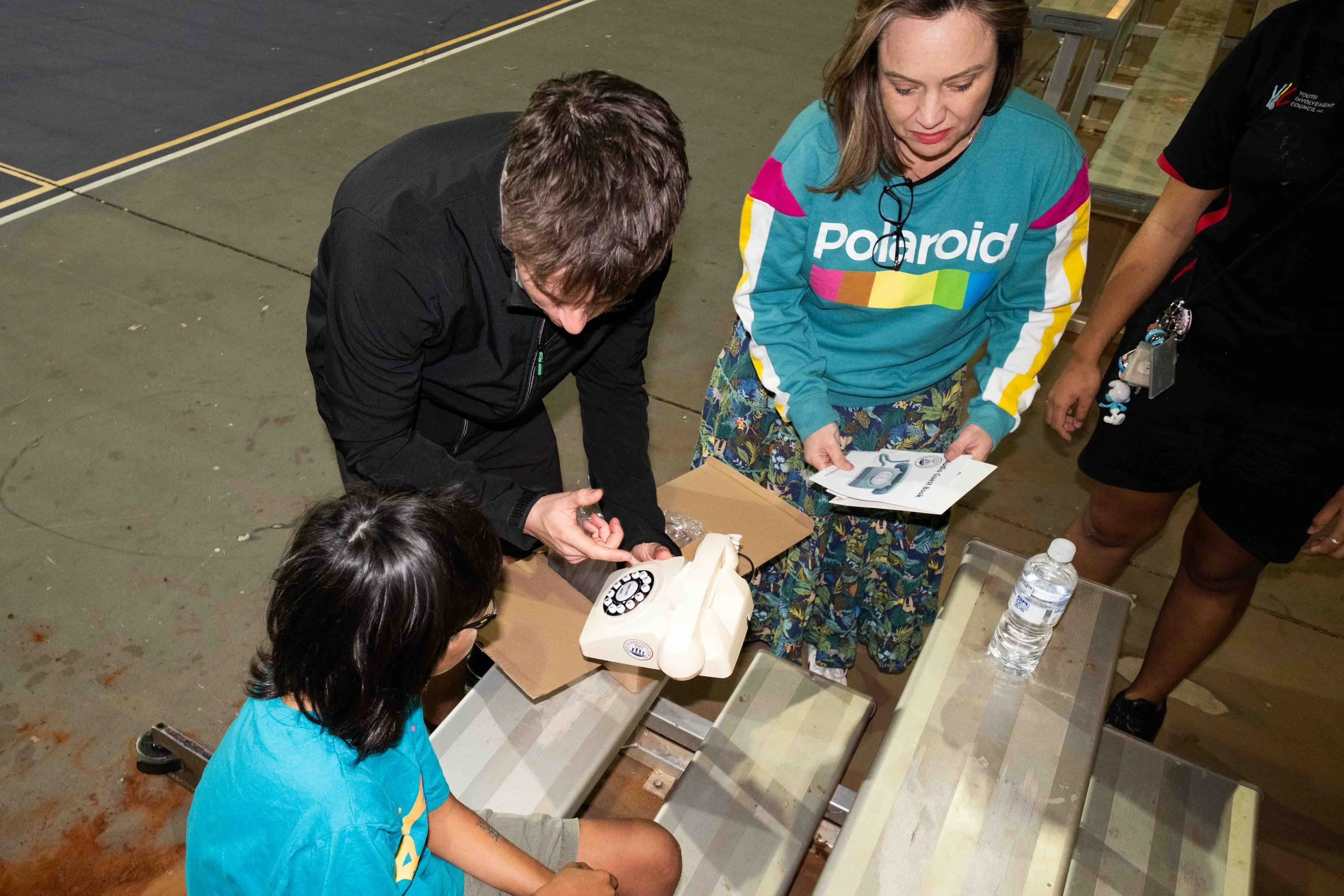
Sarah Quinton and a youth worker from the Youth Involvement Council speaking to a young person for the End Child Poverty campaign.
Months before the nation was confronted with revelations about children in South Hedland, we visited the remote town to see child poverty and disadvantage firsthand.
Hosted by The Youth Involvement Council, we visited the now famous house on Frisby Court. Through the fly screen, I saw a young person sitting on a dirty mattress without sheets or blankets. Drawings on the wall, a broken car sat outside, and another quiet young person was mucking around on a wheelchair, embedded in the sand, going nowhere.
As kids piled onto the bus, the workers called them ‘bub’ or ‘bestie’. The trust between the kids and the workers was so deep, when the kids recognised the bus, they would run to jump on.
Across our four-day visit, we heard about hunger, violence, sexual abuse, kids on curfew and many not attending school. Some of the stories I heard, I won’t repeat. It would only serve to blame the parents and not the system. One that hides the living reality of these children behind a convenient veil absent of data collection, transparent reporting and timely responses.
We came to listen. We set up a vintage-style telephone so children could record what mattered without cameras, shame or name or faces. And they were honest.
Children spoke about food, housing, school, friendship, safety, culture and their hopes for the future. They want homeless shelters, clean streets and even a footy stadium. One child said: “Listen — take me seriously.”
That is a human right, not an extraordinary request.
Yet too often in Australia, children become visible only after something has gone terribly wrong.
This newspaper’s reporting has exposed a national disgrace.
But these distressing details must not become political ammunition or fleeting outrage.
The question is: why do our systems so often recognise the seriousness of disadvantage only after it has become a public relations crisis?
Local workers, families and children already see the warning signs: hunger, overcrowding, unstable housing, violence, substance use, school absences, transport barriers, workforce shortages and service gaps.
The Youth Involvement Council internal data shows 6300 occasions of food support in the 12 months to June 2026 through meals and grocery assistance. Workers repeatedly said food insecurity was the biggest issue among the children and families.
But public data tells a different story. The recent Make Renting Fair campaign found rents have ballooned by 500% in Port Hedland where a five-bedroom house now costs $1700/week. But with an average weekly wage of $3500/week, what’s the problem?
Australia lacks an official child poverty definition or measure, dedicated national legislation, and timely, local, child-centred data to understand children’s experiences and respond early.
Governments collect extensive data through State and Federal service contracts, but much remains unavailable publicly. Does it show whether children can sleep, study, eat, feel safe and access help before crisis?
There is a disconnect from reality to those in Canberra, where governments measure, plan and invest.
What we fail to measure, we struggle to see. And what we fail to see, we fail to prioritise.
What we saw were children deeply connected to culture, speaking language and understanding their skin groups. But their clothes were dirty and they were hungry. In September, The End Child Poverty campaign played the recorded messages to politicians at Parliament House in Canberra. They listened, and some even recorded a message in return, but will anything be done?
No one is collecting the rich data of children’s experiences on a national scale.
Australia needs durable national machinery that survives elections, portfolio changes and media cycles: a child-centred definition of poverty, nationally consistent measures, local and regional data, measurable reduction targets, regular public reporting and clear responsibility for coordinating housing, income support, health, education and family services.
Children’s needs cross ministerial portfolios. Housing instability disrupts education, health and friendships; financial stress squeezes food budgets. Fragmented services delay help. “Not my portfolio” is no answer in South Hedland.
Data strengthens the case for acting much earlier on child protection issues.
Information about hardship should trigger assistance, not punishment. Aboriginal organisations and communities must have a central role in determining how information is collected, interpreted and used.
And children themselves must be participants.
The children we met in South Hedland did not describe themselves as statistics or policy problems. When I checked in with YIC, while MPs used their speaking minutes in parliament, they said, ‘it’s business as usual, the kids have been moved out of Frisby Court, but there are plenty more houses like that and our work keeps going’.
Media scrutiny matters. But attention after tragedy is not prevention.
The test for Australia is whether we can build systems that value children before crisis, listen before making decisions and remain accountable after the headlines move on.